Introduction
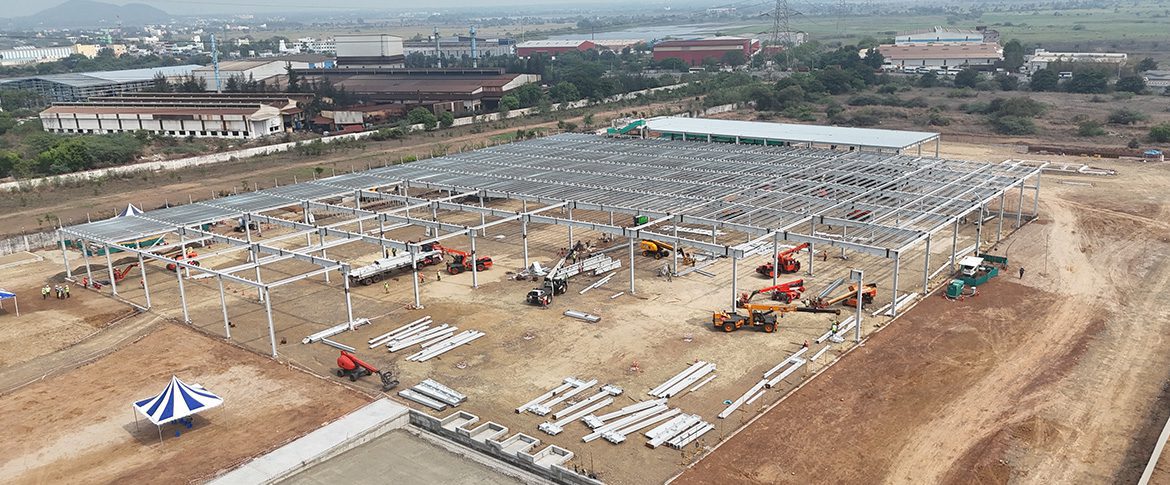
Industrial manufacturing facilities demand more than a strong structural framework. They require accurate engineering, controlled fabrication, efficient logistics, safe erection, and coordinated project delivery. The Hyundai Kefico factory project in Sriperumbudur, Tamil Nadu, demonstrates how a large-scale industrial steel project can be managed through an integrated execution approach. According to Lingam Metal’s project information, the factory involved a total steel requirement of 1,450 MT and was executed for Dongyang E&C India Pvt Ltd between March and July 2025.
The project covered the complete structural execution cycle, from shop drawing detailing and raw-material procurement to fabrication, transportation, erection, installation, and handover. This end-to-end workflow illustrates how a Pre-Engineered Building in Chennai and surrounding industrial regions can be planned around project requirements, fabrication accuracy, site coordination, and delivery schedules rather than treating construction as a series of disconnected activities.
Why Industrial Facilities Prefer PEB Construction?
Large manufacturing facilities often require considerable structural steel, open working areas, equipment-support provisions, service access, and construction schedules that align with broader industrial development plans.
Traditional construction can involve extensive site-based fabrication and multiple activities running sequentially. PEB systems shift a significant portion of structural manufacturing into a controlled fabrication environment before components reach the project site.
For industries evaluating a Pre-Engineered structure in Chennai, this approach can provide several practical advantages:
- Faster fabrication and erection: Steel components can be manufactured while other site activities progress.
- Controlled fabrication: Cutting, welding, drilling, assembly, and finishing can be managed systematically.
- Efficient material utilization: Structural members are engineered according to project loads and requirements.
- Simplified site assembly: Fabricated components arrive ready for planned erection sequences.
- Future adaptability: Industrial buildings can be designed with expansion and operational changes in mind.
Lingam Metal states that our PEB services focus on quick installation, durability, and structural strength for demanding industrial environments. Our working process includes engineering, procurement, production, quality control, and erection.
Hyundai Kefico Project Execution: From Design to Delivery
The Hyundai Kefico project involved a 1,450 MT factory building in Sriperumbudur, with Lingam Metal responsible for complete structural execution from detailing through handover. The documented scope provides a useful view of how a major industrial steel project can be divided into coordinated execution stages.
1. Shop Drawing and Engineering Detailing
Before fabrication begins, structural information needs to be translated into detailed fabrication drawings. Shop drawings communicate dimensions, member details, connection information, plate requirements, openings, and assembly relationships to the fabrication team.
For an industrial facility, accuracy at this stage is critical because even relatively small dimensional inconsistencies can create difficulties during assembly. Detailed engineering therefore establishes the information required for subsequent procurement, fabrication, transportation, and erection.
2. Raw Material Procurement
Once structural requirements are finalized, appropriate raw materials are procured according to the project specifications. Material selection has a direct influence on structural performance, fabrication quality, and long-term durability.
Lingam Metal states that it procures industry-grade raw materials from reliable vendors. Its wider fabrication capability includes projects requiring large quantities of structural steel, supported by dedicated fabrication infrastructure.
3. Precision Fabrication
Fabrication converts engineering drawings into physical structural components. Depending on the design, this can involve cutting, drilling, welding, plate assembly, preparation, and finishing.
For a project of this scale, maintaining dimensional consistency across numerous structural components is essential. Fabrication must therefore be coordinated with the approved drawings and planned erection sequence so that components can be assembled efficiently at the site.
For clients evaluating a pre engineered steel building company in Chennai, fabrication capacity should consequently be assessed alongside engineering expertise, quality systems, production capability, and site execution experience.
4. Transportation to the Project Site
After fabrication, the structural components need to reach the project location in the correct sequence and condition. Transportation becomes particularly important in large industrial projects because structural members may vary considerably in size and weight.
Effective dispatch planning can reduce unnecessary storage at the site and support the planned erection sequence. It also requires coordination between the fabrication facility, logistics team, site personnel, and erection contractor.
5. Erection and Installation
The final structural transformation takes place at the project site. Fabricated components are positioned, aligned, connected, and progressively assembled into the building framework.
A planned erection sequence helps coordinate cranes, lifting equipment, manpower, access routes, temporary supports, and safety controls. Site teams must also verify alignment and connections as erection progresses rather than waiting until the entire structure is assembled.
Lingam Metal identifies erection as part of its end-to-end structural execution process and states that its capabilities extend from fabrication to site installation.
6. Final Handover
Project completion is not limited to placing the last structural member. Final handover requires the completed work to be reviewed against project requirements, with outstanding activities addressed before delivery.
In this project, Lingam Metal’s scope specifically extends through erection, installation, and handover, making the execution model an integrated workflow rather than fabrication alone.

Contact Us!
Structural Considerations for Automotive Manufacturing Facilities
Automotive manufacturing environments can involve production machinery, material movement, storage, utilities, access requirements, and future modifications. Therefore, the structural system needs to be developed around the intended industrial operation.
Important considerations can include:
- Building dimensions and clear spans
- Dead and live loads
- Wind loads based on the project location
- Equipment and service requirements
- Crane or material-handling provisions where applicable
- Roof and wall systems
- Openings and access points
- Corrosion protection
- Future expansion requirements
- Site-specific erection constraints
A Pre-Engineered structure in Chennai must therefore be designed according to the actual project rather than selected solely on standard dimensions or generic cost assumptions.
How Fabrication Quality Influences Project Delivery?
Structural quality begins well before erection. A fabrication error can affect component fit-up, installation sequence, connection alignment, and site productivity. Quality control should consequently be integrated throughout procurement and manufacturing.
Typical control points include:
| Stage | Quality Focus |
| Material Procurement | Material specifications and documentation |
| Cutting | Dimensional accuracy |
| Drilling | Hole position and tolerance |
| Welding | Weld quality and dimensional control |
| Assembly | Member alignment and fit-up |
| Surface Preparation | Appropriate preparation before coating |
| Final Inspection | Dimensions, finish, and readiness for dispatch |
| Site Erection | Alignment, connections, and installation accuracy |
Lingam Metal describes quality control as one of the stages within its working process and highlights industry-grade material procurement as part of its structural execution approach.
PEB Construction vs Conventional Industrial Construction
The selection between a PEB system and conventional construction depends on
- Structural requirements
- Site conditions
- Design complexity
- Project schedule,
- Budget.
A comparison can help project owners understand the practical differences.
| Parameter | PEB Construction | Conventional Construction |
| Fabrication | Predominantly controlled off-site | More site-dependent |
| Erection | Planned component assembly | Often more construction-intensive |
| Construction Speed | Generally faster | Can require longer site activity |
| Material Optimization | Engineering-led | Depends on structural design |
| Site Labour | Potentially lower | Often higher |
| Expansion | Can be incorporated into design | May require greater modification |
| Quality Control | Controlled fabrication environment | More activities may occur on site |
| Project Coordination | Integrated engineering-to-erection workflow | Multiple construction stages |
For businesses researching pre engineered buildings cost in Chennai, however, construction price should not be assessed only from the steel rate.
Building dimensions, steel tonnage, structural complexity, roofing and cladding, transportation distance, erection requirements, site conditions, and project-specific specifications can all influence the final cost.
Key Specifications to Consider in an Industrial PEB Project
Specifications should be established according to the structural design and operational requirements rather than copied from another project.
| Specification | Project Consideration |
| Structural Steel | Grade and section requirements based on design |
| Building Dimensions | Length, width, height, and clear-span requirements |
| Roof System | Roofing profile, insulation, drainage, and loading |
| Wall Cladding | Panel type, thickness, insulation, and finish |
| Design Loads | Dead, live, wind, seismic, and equipment-related loads as applicable |
| Connections | Bolted and welded connections according to engineering requirements |
| Corrosion Protection | Coating and surface-preparation system |
| Openings | Doors, ventilation, utilities, and service requirements |
| Future Expansion | Provision for additional bays or extensions where required |
| Erection | Crane access, sequencing, temporary support, and safety planning |
For companies comparing Pre Engineered Building Manufacturers in Chennai, these technical parameters provide a more meaningful basis for evaluation than comparing quotations alone.
Why Every Stage of Industrial Construction Must Work Together?
Large structural projects involve several connected activities. Engineering affects procurement; procurement affects fabrication; fabrication affects transportation; and transportation affects erection. A delay or error at one stage can therefore influence subsequent activities.
An integrated contractor can coordinate these stages through a single project workflow. Lingam Metal describes its capabilities as covering engineering, procurement, production, quality control, and erection, while the project-specific scope for this factory included detailing, raw-material procurement, fabrication, transportation, erection, installation, and handover.
This approach can be particularly relevant when evaluating Pre-Engineered Building Manufacturers in Chennai, because industrial buyers need to consider not only manufacturing capacity but also project coordination and site execution.
How Industrial Experience Supports Better Project Execution?
A contractor’s project history can help industrial buyers understand its exposure to different structural scales and applications. Lingam Metal’s published portfolio includes a range of industrial projects, including a 2,000 MT Samsung India Electronics utility project, a 1,600 MT Seoyon E-Hwa factory, a 790 MT Woosu Automotive factory, and the 1,450 MT factory discussed here.
For project owners, this type of documented experience can be useful when comparing a pre engineered steel building company in Chennai. The evaluation can consider project tonnage, industry type, execution scope, fabrication capacity, erection capability, and evidence of completed work.
Final Words
The Hyundai Kefico factory project illustrates how large industrial steel construction depends on coordinated execution rather than fabrication alone. With a documented 1,450 MT steel requirement and a scope covering detailing, procurement, fabrication, transportation, erection, installation, and handover, the project demonstrates the importance of integrating every stage of structural delivery.
For companies planning industrial facilities, selecting a capable Pre-Engineered Building in Chennai partner should therefore involve evaluating engineering expertise, fabrication quality, project coordination, site execution, and documented industrial experience.
Looking for Industrial PEB Execution Support?
Discuss your structural requirements withLingam Metal Infrastructure for project-specific engineering, fabrication, transportation, erection, and handover support.
Frequently Asked Questions:
1. What makes PEB suitable for large industrial factories?
PEB systems combine engineered steel components with controlled fabrication and planned site erection. This can support faster construction, consistent fabrication quality, efficient material use, and future adaptability when the design is developed around the facility’s operational requirements.
2. What factors influence pre engineered buildings cost in Chennai?
The cost can depend on building dimensions, structural steel quantity, design loads, architectural requirements, roofing and cladding specifications, transportation, erection, site conditions, and additional requirements such as cranes, insulation, or future expansion provisions.
3. How should companies select Pre Engineered Building Manufacturers in Chennai?
Companies can evaluate manufacturers based on engineering capabilities, fabrication capacity, raw-material sourcing, quality-control procedures, documented project experience, transportation coordination, erection capability, safety practices, and ability to manage the complete project lifecycle.
4. What is involved in executing a Pre-Engineered structure in Chennai?
A typical industrial project can involve engineering and detailing, procurement, fabrication, quality control, transportation, site erection, installation, inspection, and final handover. The exact sequence depends on the building design and project requirements.
5. Why is fabrication quality important in PEB projects?
Fabrication accuracy directly affects component fit-up, structural alignment, connection quality, erection productivity, and project timelines. Controlled manufacturing and inspection at different stages can help identify dimensional or workmanship issues before components reach the construction site.