Introduction
In today’s fast-evolving infrastructure landscape, choosing the right team for a tubular steel structure project can determine whether your investment and project delivers long-term strength or recurring structural issues. From industrial sheds to transmission towers, tubular systems demand precise engineering, skilled fabrication, and seamless on-site execution.
Businesses across India are increasingly adopting tubular construction for its superior load-bearing efficiency and design flexibility. However, without an experienced team, challenges such as welding defects, structural misalignment, and project delays can escalate costs.
This blog explains why partnering with experts like Lingam Metals ensures structural durability, safety compliance, and cost-effective project delivery.
Why Is Experience Crucial in a Tubular Steel Structure Project?
Choosing a seasoned team for a tubular steel structure project ensures precision at every stage: from concept and engineering design to fabrication and site erection.
1. Precision Engineering and Structural Accuracy
Tubular systems behave differently under stress compared to conventional beams. Engineers must account for axial loads, torsional forces, wind resistance, and seismic conditions.
Experienced professionals understand the nuances of Tubular and steel structures, ensuring accurate calculations and optimized material usage.
2. Superior Fabrication Techniques
The success of fabrication tubular steel structure projects depends on advanced machinery and skilled workmanship. CNC cutting, robotic welding, and precision bending reduce dimensional errors and ensure uniformity.
For more information about blogs click here!
3. Compliance with Safety and Quality Standards
Industrial and infrastructure projects demand strict adherence to IS codes and safety regulations.
High-quality Structural steel fabrication ensures every weld, joint, and connection meets inspection requirements.
4. Efficient Project Management
Timelines matter. Delays can escalate costs and disrupt operational schedules. An experienced team streamlines procurement, production, logistics, and erection, which ensuring seamless tubular construction from start to finish.
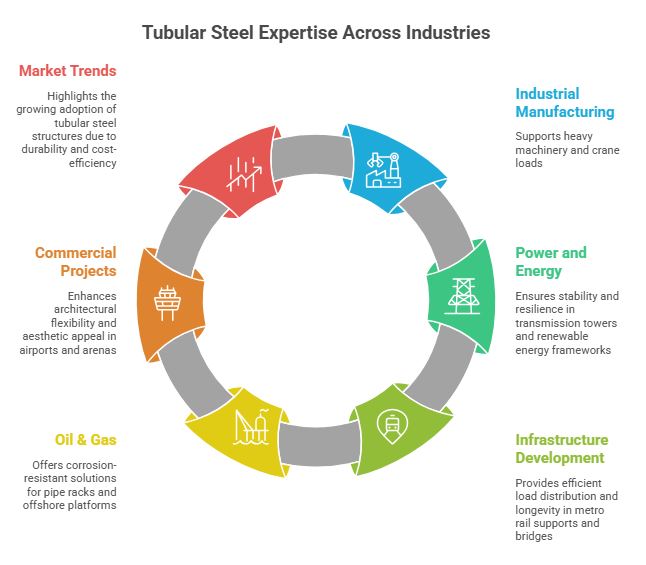
Sectors Powered by Tubular Steel Expertise
Sectors Powered by Tubular Steel Expertise
An experienced contractor in tubular steel construction in India serves diverse industries:
1.Industrial Manufacturing
Factories and warehouses require durable tubular structure systems capable of supporting heavy machinery and crane loads.
2.Power and Energy
Transmission towers, substation structures, and renewable energy frameworks rely heavily on tubular steel structure engineering for stability and resilience.
3.Infrastructure Development
Metro rail supports, pedestrian bridges, telecom towers, and highway structures depend on Tubular and steel structures for efficient load distribution and longevity.
4.Oil & Gas
Pipe racks and offshore platforms demand corrosion-resistant fabrication tubular steel structure solutions.
5.Commercial Projects
Airports, sports arenas, and exhibition halls prefer tubular construction for architectural flexibility and aesthetic appeal.
Approximately 65% of industrial facilities and 70% of energy infrastructure projects now use tubular steel structures due to enhanced durability, while 55% of commercial construction sectors choose it for cost-efficient load-bearing performance.
What Happens Without an Experienced Team?
When projects are handled without the right expertise, businesses frequently encounter repeated setbacks such as design errors, welding defects, structural misalignment, compliance failures, budget overruns, delays, and costly rework that impacts performance.
- Inaccurate load calculations
- Poor welding penetration and joint weakness
- Structural misalignment during erection
- Budget overruns due to rework
- Non-compliance with safety norms
- Increased long-term maintenance costs
An improperly executed tubular steel structure can endanger safety, reduce structural reliability, and increase long-term costs. Choosing an experienced and capable partner helps prevent failures, delays, and financial losses effectively.
Industry reports indicate that construction projects handled by inexperienced teams face up to 30% cost overruns and 20% schedule delays, with quality defects significantly increasing long-term maintenance expenses.
Comparison: Experienced Team vs Inexperienced Contractor
Choosing between an experienced team and an inexperienced contractor significantly impacts structural performance, project timelines, safety standards, and overall investment returns.
| Parameter | Experienced Team | Inexperienced Contractor |
| Design Accuracy | Detailed structural modeling | Basic estimation |
| Welding Standards | Certified welders & inspections | Inconsistent weld quality |
| Material Utilization | Optimized and cost-efficient | Excess wastage |
| Compliance | Meets IS & global codes | Risk of non-compliance |
| Timeline Management | Structured execution | Frequent delays |
| Durability | Long-term structural stability | High maintenance risk |
The right expertise ensures durability, compliance, efficiency, and cost control, while inexperience often results in delays, defects, and long-term risks.
What Makes Tubular Systems a Strategic Choice?
A tubular steel structure delivers both technical efficiency and cost benefits, combining superior strength, optimized material usage, faster installation, and long-term durability for diverse industrial and infrastructure applications.
- Higher torsional resistance
- Lightweight yet strong framework
- Reduced material consumption
- Faster erection timelines
- Improved aesthetic design flexibility
These benefits clearly demonstrate why tubular steel construction in India is rapidly gaining acceptance across industries, driven by its strength, efficiency, cost-effectiveness, and adaptability to modern infrastructure demands.
Why Partner with Lingam Metals?
As a leading metal beams and construction equipment manufacturer in Chennai, Tamil Nadu, Lingam Metals combines technical expertise with practical execution capabilities.
Our strengths include:
- Advanced fabrication tubular steel structure facilities
- Experienced engineers and certified welders
- High-precision Structural steel fabrication processes
- Strict quality control protocols
- Proven track record in Tubular and steel structures
By combining engineering design, in-house manufacturing, and seamless project execution within a single system, we deliver consistent quality, operational efficiency, and complete accountability at every stage.
Final Words
Choosing an experienced team like Lingam Metals for your tubular steel structure project guarantees precision engineering, long-term durability, strict safety compliance, and cost efficiency.
With deep technical expertise, advanced fabrication capabilities, and disciplined project management, Lingam Metals delivers dependable tubular solutions customized to complex industrial and infrastructure requirements, helping you protect your investment and achieve lasting structural performance.
Partner with Lingam Metals today for reliable, precision-built tubular steel structures that stand the test of time.
Frequently Asked Questions (FAQs)
1. What is a tubular steel structure?
A tubular steel structure is a framework built using hollow steel sections, offering high strength, durability, and efficient load distribution for industrial and infrastructure projects.
2. Why is experience important in tubular construction?
Experience ensures accurate load calculations, proper welding, compliance with safety standards, and timely project completion.
3. Which industries benefit most from tubular steel systems?
Industries such as manufacturing, energy, infrastructure, oil & gas, and commercial construction heavily rely on tubular structure frameworks.
4. How does tubular steel compare to conventional steel sections?
Tubular steel provides better torsional resistance, aesthetic flexibility, and improved strength-to-weight ratio.
5. What are the key factors in Structural steel fabrication?
Design precision, certified welding, corrosion protection, load analysis, and compliance testing are essential factors.