Introduction
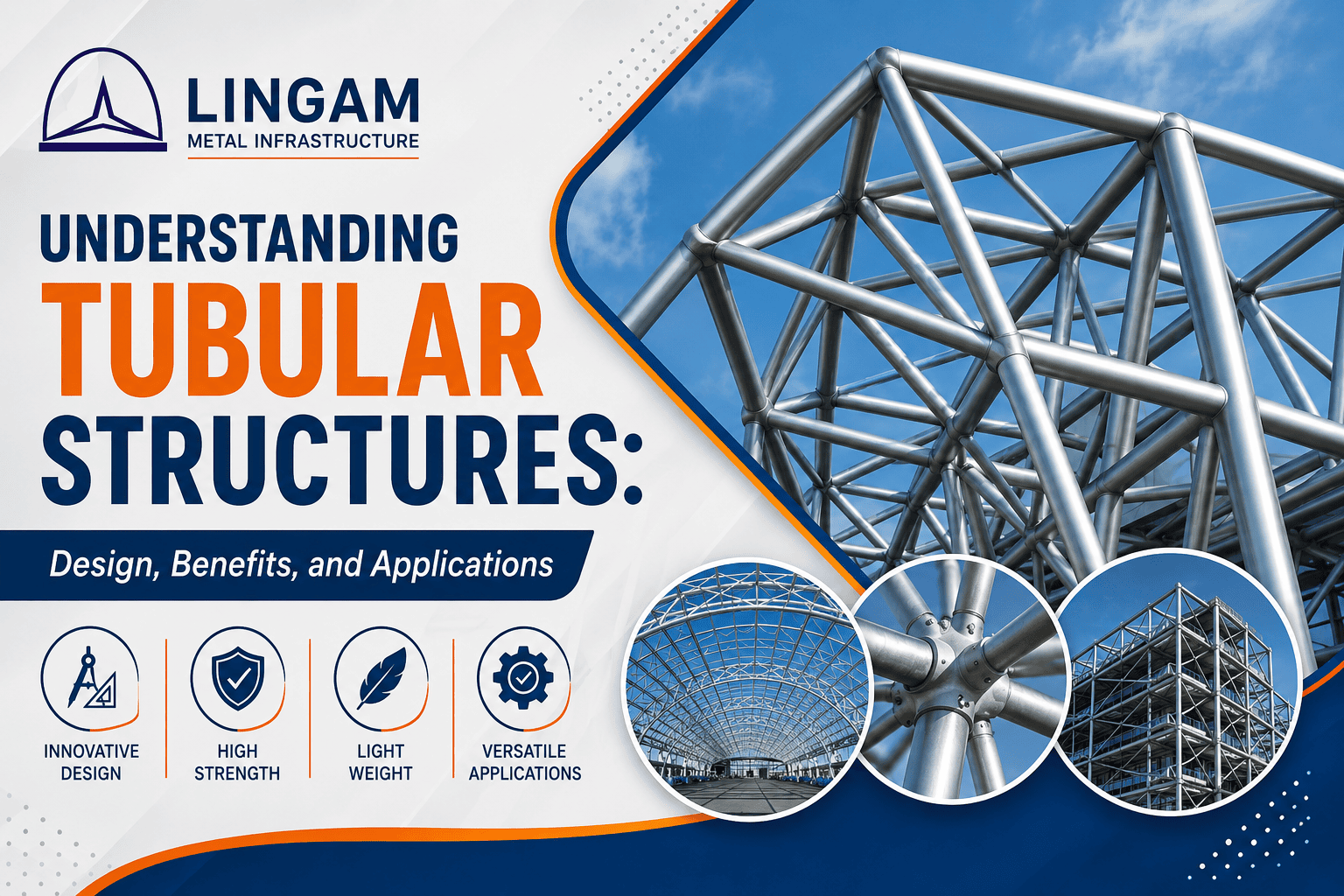
Tubular Structures are increasingly being considered for industrial buildings, infrastructure projects, warehouses, factory sheds, towers, and other applications where strength, stability, material efficiency, and faster erection are important. Unlike conventional open steel sections, tubular systems use hollow sections that can offer efficient structural performance while maintaining a relatively lightweight framework.
For project owners and contractors, understanding how tubular systems are designed and executed is essential before selecting a structural solution. A properly engineered tubular steel system can provide torsional rigidity, lateral stability, efficient load distribution, and construction flexibility.
However, its performance depends heavily on accurate engineering, fabrication, quality control, and site erection. This makes the selection of an experienced structural contractor an important project decision.
What is Tubular Structures explained in Lingam Metal?
A tubular steel structure is a structural framework made using hollow steel sections, generally available in circular, square, or rectangular forms. These sections are designed to transfer loads through the structure while providing strength around multiple axes.
- Efficient Strength-to-Weight Ratio: Provides high structural strength with less material.
- High Torsional Resistance: Offers good resistance against twisting and rotational forces.
- Lower Surface Area: Reduces the exposed area compared with some conventional open sections.
- Simplified Maintenance: Can make fabrication, painting, and maintenance more manageable.
In industrial projects, tubular construction can be used for complete structural frameworks or selected components such as towers, supports, staircases, balconies, and other load-bearing elements.
How Are Tubular Structures Designed?
The design of a tubular steel structure requires more than simply selecting a suitable hollow steel section. Engineers need to evaluate the complete structural system and understand how individual members will perform under different loads.
1. Structural Load Assessment
The first stage involves identifying the loads acting on the proposed structure. These may include dead loads, imposed loads, equipment loads, wind loads, and other project-specific forces.
Building usage, location, dimensions, and environmental conditions also influence the design.
2. Section Selection
Engineers select suitable tubular sections according to the required load capacity, span, dimensions, structural configuration, and connection requirements.
The objective is to achieve the required performance without unnecessarily increasing material consumption.
3. Connection and Joint Design
Connections are critical to structural performance. Welding, bolting, joint geometry, alignment, and load transfer must be properly detailed.
Accurate shop drawings help fabricators manufacture components according to the approved structural design.
4. Fabrication and Erection Planning
Design should also consider transportation, fabrication sequence, component dimensions, site accessibility, lifting requirements, and erection procedures. Integrating these factors at the design stage can help minimise construction complications.
Key Benefits of Tubular Structure Steel Construction
i) High Strength-to-Weight Efficiency
One of the major advantages of tubular systems is their efficient use of steel. Hollow sections can provide considerable structural strength without necessarily requiring excessively heavy members. This can help engineers optimise the overall structural framework.
ii) High Torsional Rigidity
Tubular sections can offer strong resistance to twisting because material is distributed around the section. This makes them useful for structures where torsional performance and stability are important.
iii) Reduced Structural Weight
An appropriately engineered tubular system may reduce the amount of steel required for certain applications. Lingam Metal Infrastructure states that tubular structures can provide structural weight savings of up to 30%, depending on project requirements and design.
iv) Better Lateral Stability
Tubular members can provide useful resistance against lateral forces, making them suitable for structures exposed to wind and other environmental loads. Proper engineering remains essential to determine the actual performance required for each project.
v) Faster Fabrication and Erection
Tubular components can be fabricated according to detailed drawings and transported to the project site for assembly. A well-planned fabrication and erection process can reduce site work and contribute to faster project execution.
Vi)Lower Surface Area
The compact profile of hollow sections can reduce exposed surface area compared with some open structural sections. Depending on the project, this can simplify surface treatment and contribute to reduced fabrication and maintenance requirements.

Contact Us!
Why Choose Tubular Structure Steel Construction for Industrial Projects?
Industrial buildings often require structural systems that combine strength, durability, construction efficiency, and adaptability. A tubular structure in india can be considered where these requirements align with the project’s engineering objectives.
Key reasons include:
- Efficient material utilisation: Hollow sections can provide an effective balance between structural capacity and steel consumption.
- Structural stability: Tubular members can provide good resistance to torsional and lateral forces.
- Lightweight framework: Optimised designs can reduce the overall structural weight.
- Construction efficiency: Prefabricated members can support organised site erection.
- Design flexibility: Tubular systems can be adapted for different building geometries and applications.
- Clean appearance: Their compact profiles can create a neat and modern structural finish.
- Industrial versatility: They can be incorporated into warehouses, sheds, towers, supports, and infrastructure projects.
Applications of Tubular Steel Structures
The versatility of tubular steel construction in india allows these systems to be considered across several industrial, commercial, and infrastructure applications.
| Application | Structural Advantage |
| Warehouses | Efficient framing and practical space utilisation |
| Factory sheds | Strength, stability, and erection efficiency |
| Industrial sheds | Suitable for demanding structural requirements |
| High-rise buildings | Flexible structural support systems |
| Commercial complexes | Strength combined with clean aesthetics |
| Stadiums | Useful for large and architecturally demanding structures |
| Railway stations | Suitable for large public-space frameworks |
| Hospitals | Adaptable structural solutions for large facilities |
| Towers | Strength and stability for vertical structures |
| Staircases and balconies | Lightweight and visually clean support systems |
For tubular structure steel building construction, the final configuration should always be determined through project-specific engineering rather than selecting a standard design for every application.
Tubular Structure vs Conventional Steel Structure
The choice between tubular and conventional steel systems depends on span, loading, design requirements, budget, fabrication capabilities, and project conditions.
| Specification | Tubular Structure | Conventional Steel Structure |
| Section type | Hollow circular, square, or rectangular sections | Open or built-up sections |
| Strength-to-weight efficiency | Generally high | Depends on selected section and design |
| Torsional performance | Strong due to closed-section geometry | Varies according to section |
| Structural weight | Can be optimised through engineering | Depends on structural configuration |
| Surface area | Relatively low | Generally higher for open sections |
| Fabrication | Requires accurate cutting and joint fabrication | Depends on section and connection design |
| Appearance | Compact and modern | Conventional industrial appearance |
| Applications | Industrial, infrastructure, architectural | Broad structural applications |
This comparison does not mean one system is universally better than another. An experienced engineer should evaluate the project’s structural, operational, environmental, and economic requirements before recommending a solution.
Why Choose Lingam Metals for Tubular Steel Construction in India?
For companies planning tubular steel construction in india, selecting a contractor should involve more than checking fabrication capacity. Proven engineering expertise, documented project execution, quality control, and site coordination are essential for achieving structural accuracy and dependable project delivery. Lingam Metal Infrastructure brings these capabilities together through:
- Engineering & detailing: Project-specific structural detailing and coordinated fabrication drawings.
- Precision fabrication: Controlled manufacturing processes focused on dimensional accuracy and fabrication quality.
- End-to-end execution: Integrated procurement, fabrication, transportation, erection, installation, and handover.
- Proven industrial experience: Experience executing large-scale steel structures for demanding industrial applications.
This integrated capability allows project owners and contractors to coordinate multiple stages of tubular steel structure execution through a single experienced team, reducing coordination gaps between design, fabrication, and site erection.
Established in 2013, we have expanded from a specialist fabrication company into a full-service provider of PEBs, structural towers, and industrial steel solutions.
Real – Time Scenario
A strong example is the Hyundai Kefico factory project in Sriperumbudur, Tamil Nadu, which involved 1,450 MT of steel. Lingam’s scope covered detailing, raw-material procurement, fabrication, transportation, erection, installation, and final handover, demonstrating its capability to manage complex industrial steel projects through multiple execution stages.
Final Words
Tubular structures offer project owners a practical structural option where strength, stability, material efficiency, design flexibility, and construction speed are important. Their benefits, however, depend on correct engineering, accurate fabrication, and professional erection. From industrial sheds and warehouses to towers and infrastructure projects, the right tubular system can be designed around specific project requirements.
Working with experienced contractors such as Lingam Metal Infrastructure can help ensure that design, procurement, fabrication, transportation, and erection are coordinated effectively, supporting reliable execution from the initial drawing stage through final handover.
Planning a Tubular Steel Structure Project?
Whether you are developing an industrial shed, warehouse, factory building, tower, or another infrastructure project, selecting the right structural system at the planning stage can influence construction efficiency and long-term performance.
Discuss your project requirements with Lingam Metal Infrastructure for a customised structural solution
Email: lingammetalinfrastructure@lmi.org.in
Phone: +91 98407 02692 | +91 98407 02625
Website: Lingam Metal Infrastructure
Frequently Asked Questions
1. What is a tubular steel structure?
A tubular steel structure uses hollow circular, square, or rectangular steel sections as structural members. These closed sections can provide good strength-to-weight efficiency and torsional rigidity, making them suitable for industrial buildings, towers, warehouses, supports, and infrastructure applications.
2. What are the main benefits of tubular construction?
The key benefits include efficient material utilisation, high torsional rigidity, structural stability, potentially reduced structural weight, lower surface area, faster fabrication and erection, and flexibility across different industrial and infrastructure applications.
3. Where are tubular structures commonly used?
A tubular structure in india can be used for warehouses, factory sheds, industrial buildings, towers, commercial complexes, stadiums, railway stations, hospitals, staircases, balconies, and other applications where engineered tubular framing is appropriate.
4. Is tubular structure steel building construction suitable for industrial projects?
Yes, it can be suitable for industrial projects when the system is properly engineered for the required loads, span, environmental conditions, building usage, and erection requirements. The final structural solution should always be based on project-specific engineering calculations.
5. How do I select the right tubular structure contractor?
Look for contractors with proven engineering, detailing, fabrication, quality-control, transportation, and erection capabilities. Reviewing completed industrial projects and confirming whether the contractor can manage the complete execution process can also help project owners make an informed decision.