Introduction
Conventional structure remains one of the most widely adopted construction approaches across industrial, commercial, and infrastructure projects. The growing demand for industrial infrastructure has prompted project owners, contractors, and developers to evaluate different construction methods based on cost, timeline, flexibility, and long-term performance.
While conventional construction offers proven reliability and design freedom, it also presents challenges such as extended project schedules, higher labor requirements, and ongoing maintenance demands.
Understanding these factors can help businesses make informed decisions when selecting the right construction solution for their projects.
What Is a Conventional Structure?
A conventional structure is a building system designed and constructed using traditional engineering and construction methods. Unlike pre-engineered buildings, which are manufactured according to standardized designs, conventional structures are custom-designed to meet specific project requirements.
These structures typically consist of steel columns, beams, trusses, reinforced concrete elements, masonry walls, roofing systems, and other structural components that are fabricated and assembled according to detailed engineering specifications.
In industrial applications, a conventional structure is often selected when projects require:
- Customized architectural layouts
- Heavy load-bearing capacity
- Specialized equipment support
- Complex structural configurations
- Multi-story construction requirements
The adaptability of conventional construction makes it suitable for projects where standard building designs may not adequately address operational needs.
How Conventional Construction Works?
The success of any conventional structure depends on a systematic construction process involving engineering, fabrication, and site execution.
i) Design and Engineering
The process begins with site evaluation, architectural planning, and structural analysis. Engineers assess project requirements, environmental conditions, load calculations, and operational needs to create a customized design.
Detailed structural drawings are then developed to ensure compliance with Indian building standards and safety regulations.
ii) Material Procurement
After design approval, construction materials are sourced based on project specifications. These materials may include:
- Structural steel sections
- Reinforcement bars
- Cement and concrete
- Roofing sheets
- Cladding systems
- Fasteners and accessories
Quality material selection is critical to ensuring the durability and performance of the completed structure.
iii) Structural Steel Fabrication and Assembly
A key phase in the project involves Structural steel fabrication, where steel beams, columns, trusses, and support members are manufactured according to engineering drawings. This process includes:
- Cutting
- Drilling
- Welding
- Surface treatment
- Quality inspection
Accurate fabrication ensures that structural components fit together efficiently during erection and installation.
iv) On-Site Construction and Erection
Once fabricated components reach the project site, construction teams begin foundation work, structural erection, roofing installation, cladding application, and finishing activities.
Because multiple activities occur simultaneously, effective coordination between engineers, contractors, and project managers is essential for successful execution.
Studies indicate that nearly 70% of conventional construction project timelines are influenced by design coordination, fabrication, and site execution activities.
Why Conventional Structures Have Been Popular?
Although newer construction technologies continue to emerge, conventional structures remain a preferred choice for many industrial projects due to their flexibility and proven performance.
1.Design Flexibility
One of the primary reasons conventional structures remain relevant is their ability to accommodate unique design requirements. Engineers can customize layouts, dimensions, and structural configurations according to project-specific needs.
2.High Load-Bearing Capacity
Industrial facilities often house heavy machinery, storage systems, cranes, and production equipment. Conventional structures can be designed to support substantial loads while maintaining structural integrity.
3.Future Expansion Possibilities
Many businesses plan future expansion during the initial design phase. Conventional construction allows modifications and extensions without requiring a complete redesign of the facility.
4.Specialized Industrial Applications
Industries such as manufacturing, power generation, logistics, automotive, and heavy engineering frequently require customized structural solutions that conventional methods can effectively provide.
5.Proven Engineering Reliability
Decades of successful implementation across various sectors have established conventional construction as a dependable building approach capable of delivering long-term performance.

Contact Us!
Advantages of Conventional Steel Building Systems
A conventional steel building offers several advantages that make it suitable for industrial and commercial projects.
i) Superior Structural Strength
Steel provides exceptional strength-to-weight performance, allowing structures to withstand demanding operational conditions and environmental stresses.
ii) Enhanced Design Customization
Every project has unique operational requirements. Conventional steel systems allow engineers to develop customized structural solutions without being restricted by standardized templates.
iii) Long Service Life
When properly designed, fabricated, and maintained, conventional steel structures can provide decades of reliable service.
iv) Better Adaptability
A conventional steel building can be modified, expanded, or upgraded as business needs evolve, making it a practical long-term investment.
v) Improved Safety Performance
Steel components manufactured under controlled conditions contribute to consistent quality, structural stability, and enhanced safety standards.
The increasing adoption of Conventional steel construction in India reflects the growing demand for customized industrial infrastructure capable of supporting diverse operational requirements.
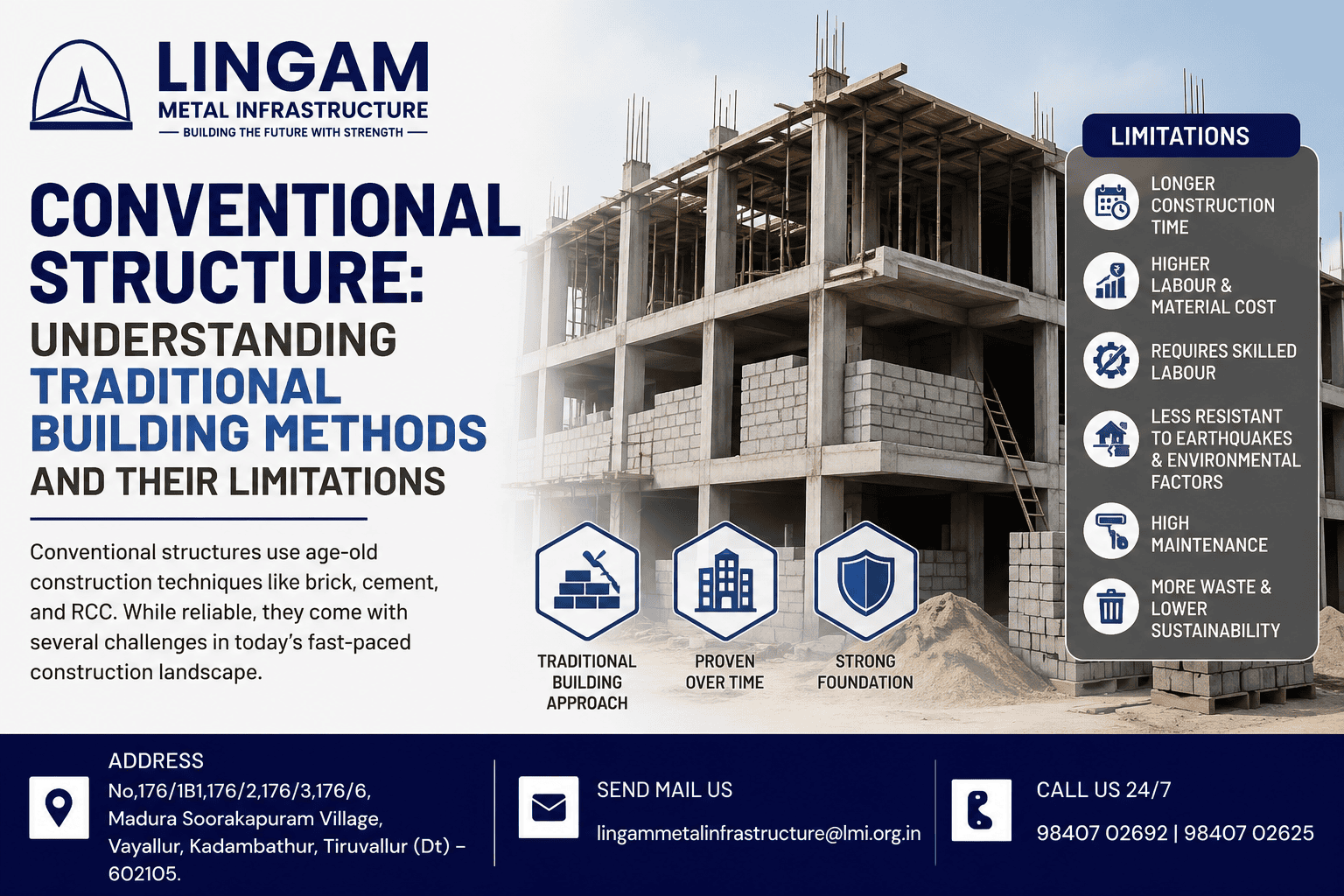
Major Limitations of Conventional Construction
While conventional construction provides significant benefits, project owners should also consider its limitations.
i) Longer Construction Timelines
Compared to modern pre-engineered building systems, conventional construction typically requires more time for design, fabrication, site preparation, and erection. Customized engineering processes can further extend project schedules.
ii) Higher Labor Requirements
Conventional projects depend heavily on skilled labor for fabrication, welding, assembly, and installation activities. Labor shortages can impact project timelines and costs.
iii) Increased Material Consumption
Because structures are individually designed rather than optimized through standardized engineering, material usage may be higher in certain applications.
iv) Cost Management Challenges
Fluctuations in material prices, labor costs, transportation expenses, and project scope changes can significantly influence overall project budgets.
v) Complex Site Coordination
Large-scale projects often involve multiple contractors, suppliers, consultants, and subcontractors. Effective communication and project management become essential for maintaining efficiency.
vi) Maintenance Requirements
Although steel structures are durable, periodic inspections, corrosion protection, repainting, and repairs may be necessary to maintain long-term performance.
vii) Weather-Related Delays
Rainfall, extreme temperatures, and adverse weather conditions can affect site activities and construction schedules.
For these reasons, businesses increasingly evaluate both conventional construction methods and modern alternatives before finalizing their infrastructure investments.
Conventional Structure vs Modern Steel Building Systems
Understanding the differences between conventional and steel structures helps project owners select the most suitable solution.
| Parameter | Conventional Structure | Modern Steel Building / PEB |
| Design Approach | Fully customized | Standardized and optimized |
| Construction Speed | Relatively slower | Faster execution |
| Site Labor Requirement | Higher | Lower |
| Material Utilization | Moderate to high | Optimized usage |
| Engineering Flexibility | Excellent | Moderate |
| Expansion Capability | Good | Excellent |
| Cost Predictability | Moderate | High |
| Maintenance Requirement | Moderate | Lower |
| Installation Complexity | Higher | Simplified |
While both conventional and steel structures offer valuable benefits, project requirements ultimately determine the most appropriate construction method.
Where Conventional Structures Are Commonly Used?
Conventional structures continue to serve a wide range of industries and applications. Common uses include:
- Manufacturing facilities
- Industrial plants
- Warehouses
- Commercial complexes
- Distribution centers
- Power generation facilities
- Engineering workshops
- Storage terminals
- Institutional buildings
- Infrastructure projects
Many of these projects require customized engineering solutions that cannot always be achieved through standardized building systems.
Future Trends in Conventional Steel Construction in India
The future of Conventional steel construction in India is being shaped by technological advancements, sustainability goals, and increasing infrastructure investments.
i) Digital Engineering and BIM
Building Information Modeling (BIM) enables better project visualization, planning accuracy, and coordination between stakeholders.
ii) Advanced Fabrication Technologies
Modern fabrication facilities are incorporating automation, CNC machinery, robotic welding, and precision cutting systems to improve productivity.
iii) Sustainable Construction Practices
Steel remains one of the most recyclable construction materials. Sustainable design strategies are encouraging greater adoption of environmentally responsible building practices.
iv) Integrated Project Management
Digital project management tools help improve scheduling, communication, quality control, and resource allocation throughout the project lifecycle.
v) Growing Demand for Fabrication Expertise
As industrial projects become more complex, demand for professional Steel fabrication services in Chennai and other major industrial hubs continues to increase. Experienced fabrication partners contribute significantly to project quality, safety, and efficiency.
Experience the Lingam Metal Infrastructure Difference
At Lingam Metal Infrastructure, we bring extensive experience in delivering customized conventional steel structures for industrial, commercial, and infrastructure projects. Our team combines engineering expertise, advanced fabrication capabilities, and project execution excellence to create structures that are built for performance, durability, and long-term value.
Strengths that set us apart include:
- Customized Engineering Solutions tailored to specific operational and structural requirements.
- In-House Structural Steel Fabrication ensuring precision, quality control, and consistency throughout the project.
- Compliance with Industry Standards through rigorous quality checks and safety-focused construction practices.
- End-to-End Project Execution covering design, fabrication, erection, and timely project delivery.
From concept to completion, our engineers work closely with clients to develop efficient structural solutions that align with project objectives, site conditions, and future expansion plans. Every component is fabricated with precision and subjected to strict quality control measures to ensure structural integrity and reliability.
As a trusted provider of Steel fabrication services in Chennai, Lingam Metal Infrastructure has successfully supported a wide range of industrial and infrastructure developments. Whether you are planning a manufacturing facility, warehouse, industrial shed, or a large-scale conventional steel structure, we deliver dependable construction solutions backed by technical expertise, quality craftsmanship, and a commitment to project success..
Final Words
A conventional structure continues to be a reliable and versatile solution for industrial, commercial, and infrastructure projects requiring customized engineering and high structural performance. While conventional construction offers flexibility, strength, and proven durability, it also involves longer timelines, higher labor requirements, and ongoing maintenance considerations.
By working with Lingam Metals, one of the experienced Conventional steel construction Contractors and trusted providers of Structural steel fabrication, businesses can maximize project value, ensure long-term reliability, and achieve successful construction outcomes.
Planning a Conventional Steel Structure Project?
Lingam Metal Infrastructure specializes in designing, fabricating, and executing customized conventional structures for industrial, commercial, and infrastructure projects. With extensive expertise in engineering, fabrication, and project execution, the company delivers reliable solutions tailored to specific business requirements.
Website: Lingam Metal Infrastructure
“With proven engineering expertise and precision execution, Lingam Metal Infrastructure builds steel structures you can depend on for years to come.”
Frequently Asked Questions:
1. What is a conventional structure in construction?
A conventional structure is a custom-designed building system constructed using traditional engineering methods, steel components, concrete, and other structural materials to meet specific project requirements.
2. How is a conventional steel building different from a PEB?
A conventional steel building is fully customized and engineered for unique project needs, while a Pre-Engineered Building (PEB) uses standardized designs optimized for faster construction and cost efficiency.
3. What are the advantages of Conventional steel construction in India?
Conventional steel construction in India offers high strength, design flexibility, customization, durability, and suitability for heavy industrial applications.
4. Why are Structural steel fabrication services important?
Structural steel fabrication ensures that steel components are manufactured accurately according to engineering specifications, contributing to structural safety, quality, and project efficiency.
5. How do I choose the right Conventional steel construction Contractors?
Look for contractors with proven industrial experience, fabrication capabilities, quality certifications, engineering expertise, and a strong track record of successful project execution.